Home battery belgium
SolarEdge home battery: price and models
The SolarEdge Home Battery 48V is built from modules of 4.6 kWh that stack up to 23 kWh. It is a low voltage, DC coupled battery, which means it sits on the direct current side of a SolarEdge inverter rather than beside your existing installation. That single design choice decides most of what follows: which inverter you need, how much energy survives the round trip, and what the whole system ends up costing.
This page covers the modules and capacities, the price per usable kWh in Belgium, what the 48V design changes in practice, and when SolarEdge is the sensible pick.
How does a SolarEdge home battery work?
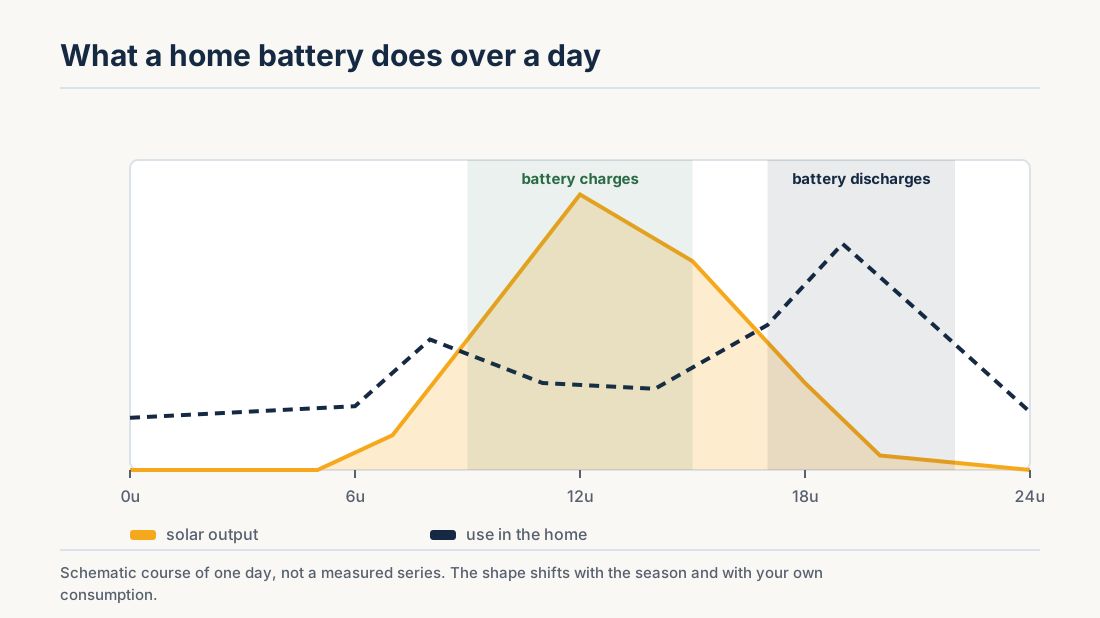
The battery stores the solar electricity you do not use the moment it is produced, and releases it when your consumption rises. Without a battery a household uses roughly 30 percent of its own solar electricity directly; with one that rises to around 70 percent. That shift is where the return comes from, not from the storage itself.
Why does DC coupling matter?
SolarEdge is DC coupled. Solar panels produce direct current and a battery stores direct current, so a DC coupled system converts once instead of twice. SolarEdge states a round trip efficiency of up to 94.5 percent for that reason.
The trade-off is dependence. A DC battery needs a compatible hybrid inverter, so you are choosing a system rather than a component. An AC coupled battery hangs beside whatever you already own and leaves the inverter alone, at the cost of an extra conversion step.
Which inverter do you need?
The battery is designed for the SolarEdge Home ecosystem and works with the SolarEdge Home Hub and Wave inverters. If you already run SolarEdge optimisers and a matching inverter, adding storage is the cheap path. If your installation is another brand, budget for replacing the inverter as well, which is usually the largest single line on the quote.
Installation itself is designed to be quick. The modules are plug and play, and commissioning runs through the SetApp smartphone application rather than a laptop on site.
What capacities does the SolarEdge Home Battery offer?
Each module holds 4.6 kWh, and because the design runs at 100 percent depth of discharge, all 4.6 kWh is usable. You stack up to five modules.
| Modules | Usable capacity | Suits |
|---|---|---|
| 1 | 4.6 kWh | modest consumption or an evening top-up |
| 2 | 9.2 kWh | average household with solar panels |
| 3 | 13.8 kWh | heat pump or electric car |
| 4 | 18.4 kWh | high evening and night consumption |
| 5 | 23 kWh | the maximum for one stack |
How does stacking modules work?
You do not have to buy the full capacity on day one. Start with two modules and add a third later without replacing what is already installed. Because every module is identical, expanding is a matter of stacking and configuring rather than redesigning the system.
Which capacity fits which household?
Size the battery on your evening and night consumption, not on your annual figure. Whatever you use during daylight comes straight from the panels and never touches the battery. For most families that lands on two modules; with a heat pump or an electric car, three.
What does a SolarEdge home battery cost in Belgium?
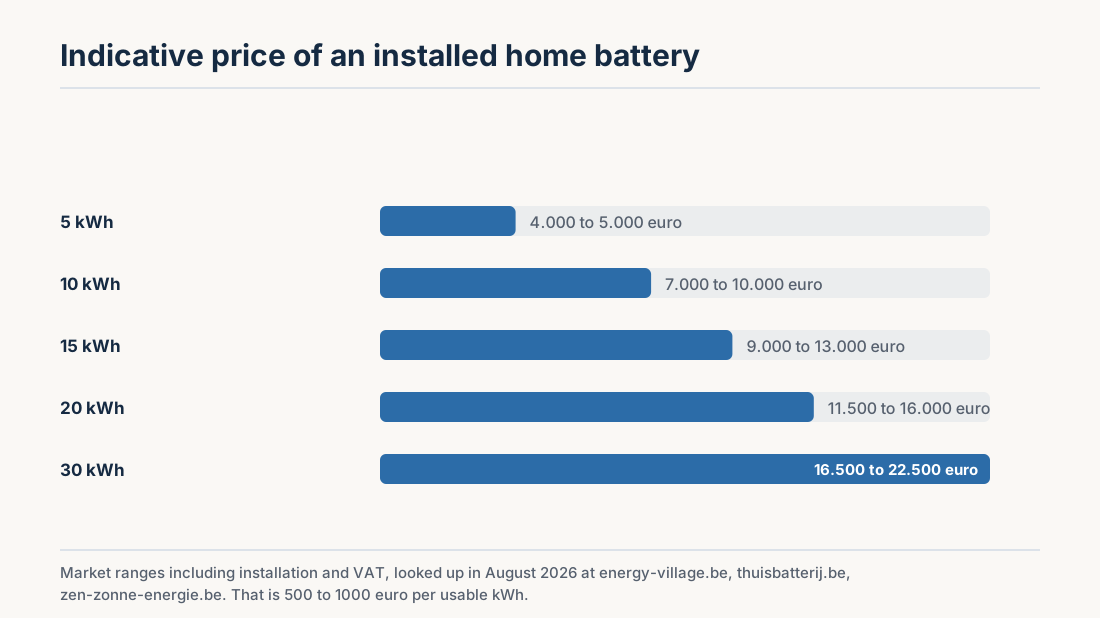
Budget €500 to €1,000 per usable kWh, installation and inspection included. That is the same band that applies to other brands; with SolarEdge the difference sits in the inverter rather than in the battery modules.
For the common sizes that means an installed system of 10 kWh between €7,000 and €10,000 including VAT, and 15 kWh between €9,000 and €13,000. The full table per capacity is on the price page.
Example calculation for a two module system
- 2 battery modules, 9.2 kWh in total: €5,200
- SolarEdge Home Hub hybrid inverter: €2,000
- installation and electrical work: €1,000
- mandatory inspection: €300
That comes to roughly €8,500 including VAT. For a home older than ten years the reduced VAT rate of 6 percent applies instead of 21 percent. No Belgian region still grants a subsidy for a home battery, so the reduced VAT rate is the only remaining financial benefit.
What does the 48V low voltage design change?
Most competing home batteries run at high voltage, in the hundreds of volts. SolarEdge deliberately stays at 48 volts, and that has practical consequences both on the quote and on site.
Low voltage equipment is safer to handle and the wiring rules are less demanding, which shortens the installation. The cells are lithium iron phosphate, the same chemistry used across this category for its thermal stability. The limit shows up at the top end: 23 kWh per stack is lower than brands that reach 30 kWh or beyond, so very high consumption pushes you towards a different system.
When is SolarEdge the right choice, and when not?
The honest summary is that SolarEdge storage makes most sense to people who are already inside the SolarEdge system, and least sense to people who are not.
What speaks for this system
- one conversion step instead of two, with up to 94.5 percent round trip efficiency
- the full 4.6 kWh per module is usable, since the design runs at 100 percent depth of discharge
- modules of 4.6 kWh let you size closer to real need than brands that move in 5 kWh or larger steps
- a single manufacturer for optimisers, inverter and battery, which keeps responsibility clear when something fails
What to take into account
- you are tied to a SolarEdge inverter, so an existing installation of another brand means replacing it
- 23 kWh per stack is the ceiling, lower than several competitors
- the battery is not sensible without solar panels, because the whole design assumes a DC source
How does SolarEdge compare with other brands?
On module size SolarEdge sits among the finer grained systems at 4.6 kWh, against 5 kWh for Huawei and 13.5 kWh for Tesla. On maximum capacity it sits at the lower end, since Huawei reaches 30 kWh and Tesla 54 kWh with expansion units. On coupling it shares the DC approach with Huawei, BYD and Pylontech, while Enphase and Marstek are AC.
The full comparison of coupling, module step and capacity per brand is on the comparison page, and the warranty conditions per brand are on the warranty page. SolarEdge is deliberately absent from that warranty table, because its warranty document was not publicly available when we checked.
Frequently asked questions
What does a complete SolarEdge battery system cost?
Budget €500 to €1,000 per usable kWh including installation and inspection. A system of roughly 10 kWh therefore lands between €7,000 and €10,000, with the hybrid inverter accounting for a larger share of that than it would with an AC battery.
How large is one SolarEdge battery module?
Each module holds 4.6 kWh and all of it is usable, because the system runs at 100 percent depth of discharge. Stacking one to five modules gives 4.6, 9.2, 13.8, 18.4 or 23 kWh. The model designation is BAT-05K48M0B-02.
Does it work with an inverter from another brand?
No. The battery is built for the SolarEdge Home ecosystem and pairs with the Home Hub and Wave inverters. If your installation uses another brand, replacing the inverter is part of the project and belongs on the quote.
Why does SolarEdge use 48 volts?
Low voltage equipment is safer to work with and simpler to wire than high voltage storage, which shortens installation. The cost is a lower ceiling: 23 kWh per stack, where high voltage systems go further.
Does a SolarEdge battery work without solar panels?
Not sensibly. The system is DC coupled and assumes a solar array feeding it directly. Without panels you would be buying a hybrid inverter to charge from the grid alone, which rarely justifies the cost.
The technical figures on this page come from the SolarEdge product documentation itself, checked in August 2026. The prices follow the indicative figures we apply across the whole site and are not a manufacturer quotation.
Read also
Ready to cut your energy bill?
Compare quotes for solar panels, home batteries and charging points.