Home battery belgium
MyGrid home battery: price and review
A MyGrid battery stores electricity in a compact, plug-in home battery backup unit that you connect directly to a wall socket, giving you immediate control over your energy usage. This plug-in home battery storage system, known as MyGrid Module One, targets apartments, renters, and small households that cannot install traditional systems. With a typical entry price around €1,750 incl.
VAT and a capacity of about 1.5 kWh, it fits between portable power stations and full home battery storage systems.
How does a MyGrid battery work exactly?
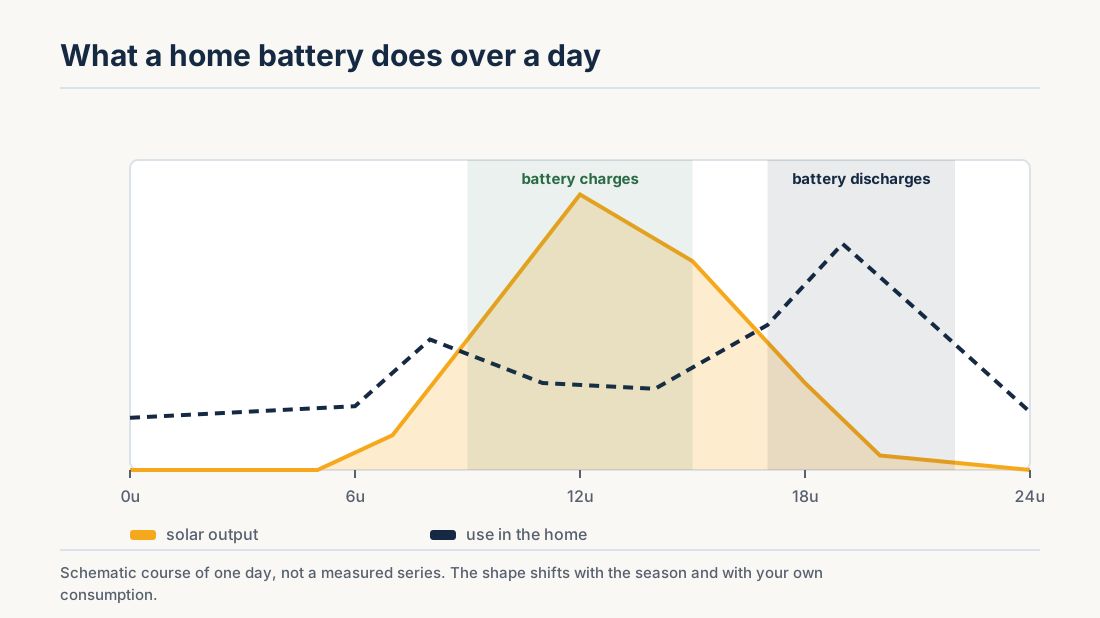
The MyGrid battery functions as a bidirectional energy buffer that charges when electricity is cheap or abundant and discharges when prices rise or demand increases. It connects through a standard socket, making it a true plug-in battery without requiring electrical modifications.
This system operates similarly to larger home battery operation principles, but in a simplified plug-and-play format. It stores energy from the grid or solar panels connected to your home network.
What role does bidirectional charging play?
Bidirectional charging means the battery both absorbs and supplies electricity through one connection point. The integrated inverter handles AC conversion internally, so you do not need an external inverter.
- Charging speed up to approximately 800 W
- Full charge cycle in roughly 2 hours
- Automatic energy flow management
How does the MyGrid login and app control energy?
The MyGrid login links the device to a mobile app and cloud platform. This app analyzes your consumption profile and schedules charging cycles automatically.
- Real-time monitoring of energy usage
- Dynamic tariff optimization
- Remote control of charging strategies
Which battery technology is used?
The MyGrid battery uses LiFePO4 lithium iron phosphate cells. This chemistry offers thermal stability, a long lifespan, and a lower environmental impact compared to standard lithium-ion batteries.
You can learn more about this technology on the LiFePO4 battery page.
What technologies or variants exist for MyGrid battery systems?
The primary product is MyGrid Module One, designed as a modular system. You can increase capacity by adding multiple units, creating a flexible alternative to traditional house batteries.
What configurations are available?
The available configurations scale linearly to match different household needs.
- 1 module: 1.5 kWh, suitable for apartments
- 2 modules: 3 kWh, suitable for small homes
- 3 modules: 4.5 kWh, suitable for families with solar panels
How does it compare to other plug-in solutions like the Pila battery?
Systems such as the Pila battery use a similar plug-in principle but vary in capacity and ecosystem integration. The MyGrid battery emphasizes simplicity and app-driven control, whereas other systems may focus on higher capacity or hybrid integration.
For a broader comparison, see the plug-in battery systems overview.
Can the MyGrid battery work without solar panels?
Yes, the system functions effectively as a home battery backup without solar panels. It charges from the grid during low tariff periods and discharges during peak hours.
More details are available on the battery without solar page.
What is the price of a MyGrid battery?
The MyGrid battery price is approximately €1,750 incl. VAT for a complete set with 1.5 kWh capacity, which positions it as one of the most affordable options in home battery storage.
This price remains significantly lower than traditional systems, which you can review on the home battery price overview.
How does the price compare to larger battery systems?
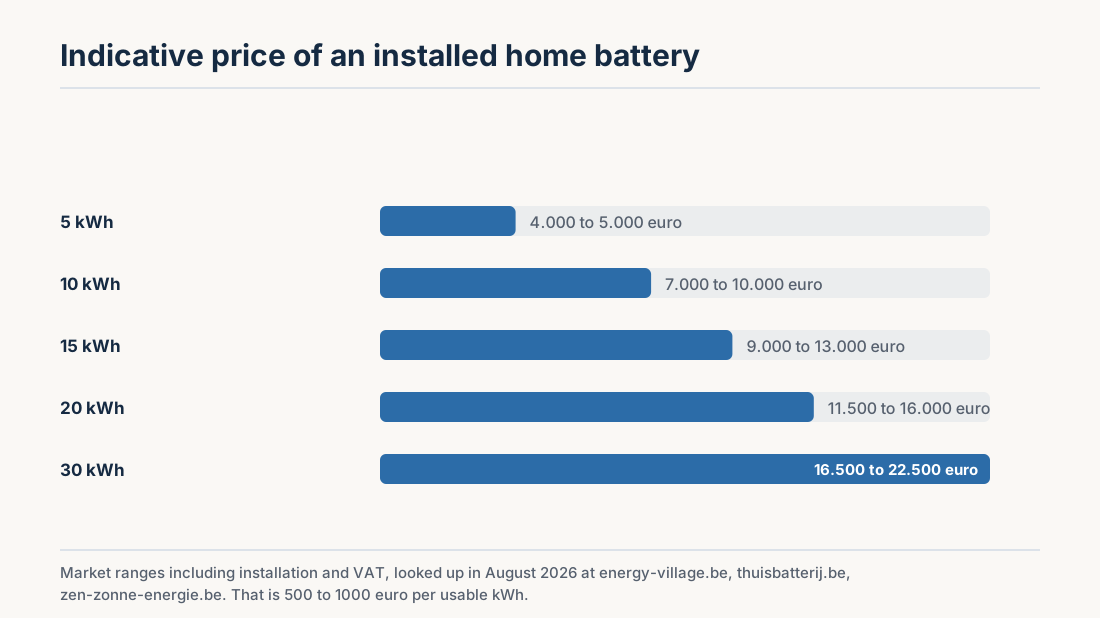
Below are the price differences between various system sizes.
- MyGrid Module One, 1.5 kWh: €1,750
- Standard home battery, 5 kWh: approximately €4,000
- Larger solar battery, 10 kWh: above €8,000
What does a modular setup cost?
A typical multi-unit configuration example is as follows.
- 2 × MyGrid Module One units: 2 × €1,750 = €3,500
- No inverter required: €0
- No installation cost: €0
- Optional smart meter integration: €150
The total investment equals approximately €3,650 incl. VAT.
What savings can you expect with a MyGrid battery?
Annual savings generally range between €100 and €300 depending on your usage patterns and energy tariffs. When combined with solar panels, savings increase due to higher self-consumption rates.
This aligns with strategies discussed on the dynamic tariff battery usage page.
In which situations does a MyGrid battery make the most sense?
The MyGrid battery suits situations where traditional battery installation is impossible or not financially practical. It prioritizes flexibility over maximum storage capacity.
Who benefits most from this system?
Ideal users include:
- Renters lacking permission to install permanent systems
- Apartment owners with limited space
- Households interested in testing energy storage solutions
When does the system work best with solar panels?
The MyGrid battery complements smaller solar setups by storing excess production and increasing self-consumption of solar energy.
Can it be used as backup power?
Yes, it supports light backup scenarios such as:
- Lighting and electronics
- Small appliances
- Portable outdoor use
For larger backup needs, see the backup power battery setups page.
What are the advantages and limitations of a MyGrid battery?
This plug-in home battery backup offers high accessibility, though limited capacity and power remain key constraints.
What are the strengths of this system?
The system eliminates common barriers to adopting energy storage.
- No need for installation or electrician
- Portable and lightweight at about 12 kg
- Safe LiFePO4 chemistry providing around 6,000 charge cycles
What limitations should you consider?
The system has clear limitations if you expect full home energy coverage.
- Limited capacity of 1.5 kWh per unit
- Unsuitable for high-power appliances
- No direct subsidies available in many regions
For larger households, fixed home battery systems are more efficient.
How does a MyGrid battery compare with a traditional solar battery?
The main differences are installation method, capacity, and scalability. A solar battery integrates directly into your electrical system, while the MyGrid battery remains an external and portable device.
What are the key differences?
The comparison below highlights the primary attributes.
- Installation: plug-in versus professional wiring
- Capacity: 1.5 kWh versus 5 to 15 kWh typical sizes
- Flexibility: portable versus fixed installation
- Use case: entry-level versus full household coverage
When should you avoid choosing the MyGrid battery?
You should consider other systems if your goal is full energy independence or powering heavy appliances. In those cases, larger systems explained on the battery comparison pages are more appropriate.
The MyGrid battery works best as an introduction to energy storage rather than a comprehensive solution.
This plug-in battery system provides a straightforward way to begin using energy storage without the need for full installation. Its greatest strengths are flexibility, an affordable entry price, and ease of use, while the main constraint is its smaller capacity. If you want to explore energy optimization or live in a rental property, this system fits well. For those aiming for full energy independence, consider comparing larger options through Soleva and request multiple quotes to find the best fit for your needs.
Frequently Asked Questions
What is the MyGrid battery review based on real usage?
A typical MyGrid battery review emphasizes its ease of use, quick setup, and portability as major advantages. Users value the plug-in design and mobile app control. Critiques focus on the limited capacity and lower output. It is best suited for small households or renters rather than large energy consumers with high daily use.
What is the price of a MyGrid battery compared to other house batteries?
The MyGrid battery starts at around €1,750 incl. VAT, whereas most house batteries begin near €4,000. This lower entry cost reflects the smaller capacity and simpler installation process. The system provides an accessible option rather than a full replacement for larger home battery storage solutions.
How does MyGrid login improve energy savings?
The MyGrid login connects your battery to smart software that monitors energy use and schedules charging during low prices. This automation reduces the need for manual control and enhances savings. The system performs best combined with dynamic tariffs and predictable consumption patterns.
Can a MyGrid battery work as a home battery backup without solar?
Yes, the battery offers home backup without solar panels by storing grid electricity during off-peak hours. You then use this stored energy when electricity prices rise. This is beneficial for households with variable tariffs, even if they do not have photovoltaic panels installed.
Is the MyGrid battery safe for indoor use?
The device uses LiFePO4 cells, which ensure high thermal stability and a reduced fire risk compared to traditional lithium-ion batteries. Built-in protections monitor temperature and load continuously. This safety design makes the battery suitable for indoor settings such as apartments, provided standard electrical safety guidelines are observed.
Indicative prices for the Belgian market, checked in August 2026 against energy-village.be, thuisbatterij.be and zen-zonne-energie.be. These are market ranges for an installed system including VAT, not a quotation: your price depends on capacity, brand and the state of your existing installation.
Read also
Ready to cut your energy bill?
Compare quotes for solar panels, home batteries and charging points.