Solar panels Belgium
Solar panels tax declaration Belgium explained
Declaring solar panels on your tax return in Belgium affects your taxes through specific deductions, VAT regulations, and mandatory forms related to your installation. The solar panels tax declaration Belgium process depends on whether you use the system for private or professional purposes and whether you qualify for incentives such as the green investment deduction.
On average, a photovoltaic system generates about 1,088 kWh per kWp annually, which influences your tax savings and return.
Read on to learn everything you need for a successful tax declaration.
What does the solar panels tax declaration in Belgium involve and how much financial benefit can you expect?
In Belgium, the solar panels tax declaration involves reporting your photovoltaic investment on your annual tax return to access fiscal benefits such as the green investment deduction and VAT reductions. Small and medium-sized enterprises (SMEs) may receive up to a 40% deduction on eligible investments, while large companies benefit from a 30% deduction on related green assets.
These deductions reduce your taxable profit rather than the invoice price. The actual financial benefit depends on your tax rate and the proportion of the installation used for professional purposes.
Which deductions apply for individuals and companies?
The main tax benefits include:
- Individuals who use the system professionally can deduct costs proportionally to that use.
- Companies can deduct the full installation cost if it is used exclusively for business.
- Depreciation allows spreading the deduction over 20 years for gradual tax relief.
- Private use of solar panels within a company is treated as a benefit in kind and taxed accordingly.
What is the 30% rule in Belgium?
The 30% rule applies to large companies investing in energy assets, allowing them to deduct 30% of qualifying investments. This rule covers a variety of green investments, including charging infrastructure connected to solar panel systems.
How can you qualify for tax incentives and what does the 20% rule entail for solar panels?
You become eligible for tax incentives if your solar panel system is new, depreciable, used for professional activities, installed in Belgium, and compliant with European energy efficiency standards.
What is the 20% rule for solar panels?
The 20% rule specifies a minimum threshold of professional use for qualifying partial tax deductions. If under 20% of the energy produced is used professionally, tax authorities may deny proportional deductions on your taxes.
How is mixed use calculated?
The calculation of mixed use involves determining the split between electricity consumed privately and professionally. This ratio defines the portion of the investment cost eligible for deduction and the VAT you can reclaim.
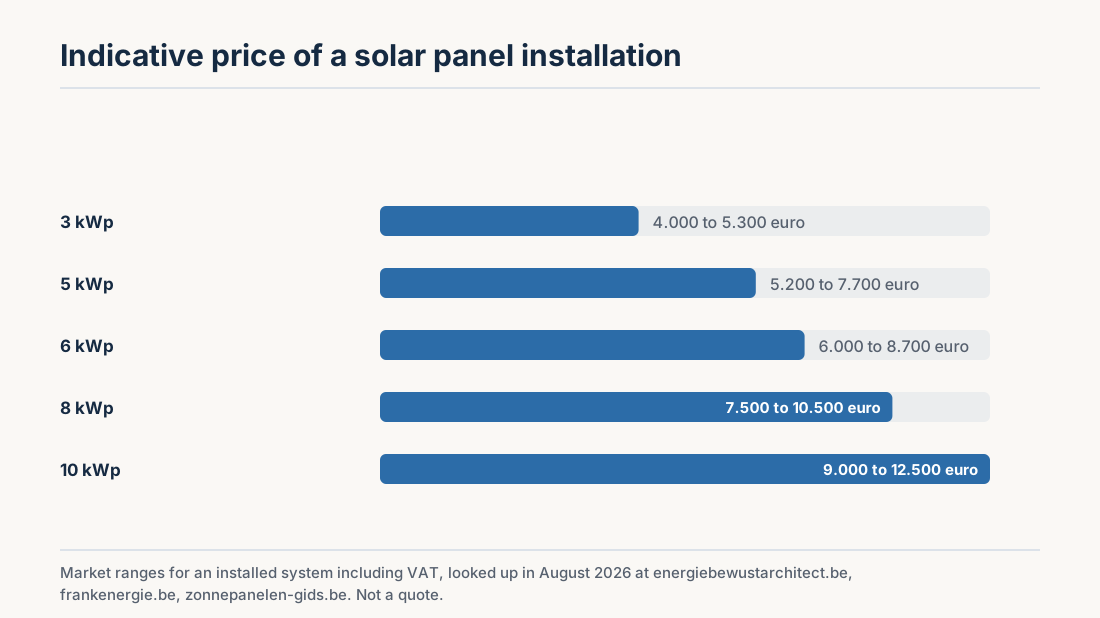
What impact does the solar panels tax declaration have on the total installation cost?
Tax declarations reduce your effective investment costs by applying deductions and VAT advantages. The initial installation cost structure remains the same as standard solar panel systems.
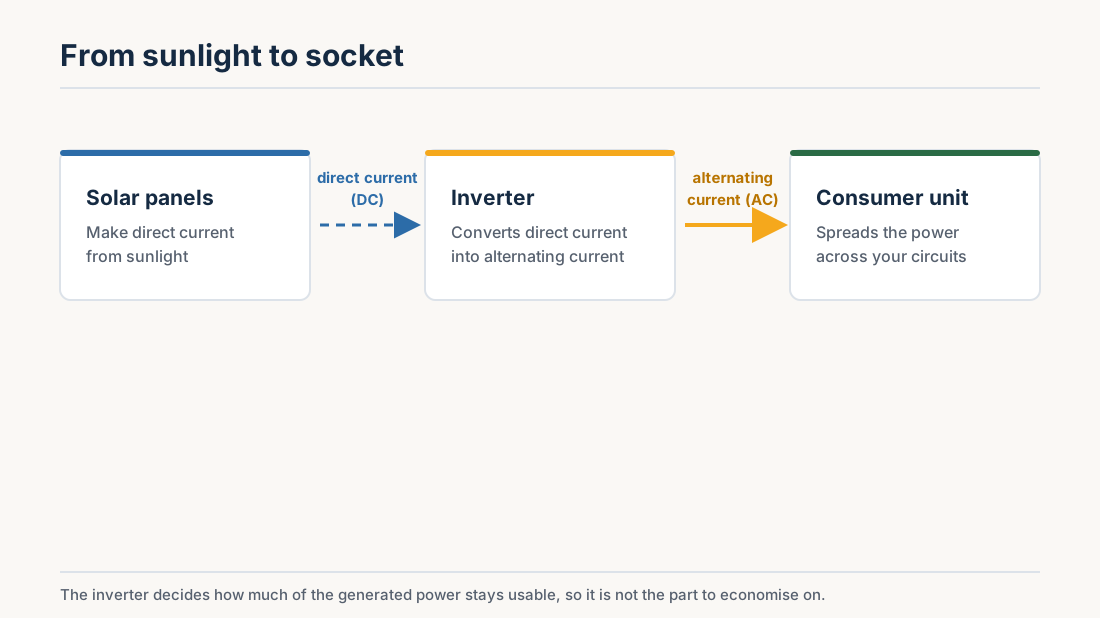
The main components of price include:
- Solar panels and inverter
- Installation and labor costs
- Electrical system upgrades
- Applicable VAT rates of 6% or 21%
Calculation example
Consider a solar system with 12 panels that costs approximately:
- Panels: 12 × €250 = €3,000
- Inverter: €1,200
- Installation: €2,000
- Electrical upgrades: €800
The total investment amounts to around €7,000 including VAT. Applying a 40% deduction on the professional use share will significantly reduce your taxable income.
How does VAT apply to solar panel installations and when is the 6% VAT rate applicable?
VAT determines whether you pay a reduced rate of 6% or the standard 21% on your installation costs. The reduced VAT rate applies when specific conditions are met.
When does the 6% VAT rate apply?
The 6% VAT rate applies if all of the following conditions are fulfilled:
- The property is used mainly as a private residence.
- The installation is invoiced directly to the end user.
- The solar system complies with EU emission and efficiency standards.
What happens if the conditions for 6% VAT are not met?
If any condition is not satisfied, the standard 21% VAT rate applies. The homeowner may then be liable for the difference and possibly associated penalties. The VAT application aligns with general rules governing residential solar installations.
What is the step-by-step process to declare solar panels and meet tax deadlines in Belgium?
Declaring your solar panels involves filing your annual tax return using specific forms depending on your status.
Which forms do you need to submit?
- Form 276U for individual taxpayers
- Form 275U in Biztax for companies
- VAT returns submitted monthly or quarterly according to your obligations
When must you submit your tax declaration?
Personal tax declarations are generally submitted mid-year via Tax-on-web. VAT returns have fixed deadlines such as the 20th or 25th day of the relevant period. Companies must follow corporate tax timelines. Failing to meet deadlines may result in penalties.
Outlined step-by-step process
- Gather all invoices and installation certificates.
- Calculate the percentage of professional use of your solar installation.
- Determine depreciation and apply eligible deductions.
- Complete the appropriate tax declaration form.
- Submit all documentation before the official deadline.
We recommend thoroughly checking your documentation before submission to avoid corrections or penalties in the future.
How do Belgian solar incentives compare internationally and what long-term benefits can you expect?
Belgium’s solar incentives focus mainly on tax deductions and VAT reductions. In contrast, some countries emphasize direct subsidies to reduce upfront costs. Belgian incentives reduce your taxable income, which indirectly lowers the overall investment burden.
What is the financial impact in the long term?
The combination of tax deductions and electricity production typically results in a payback period of 8 to 12 years. The return on investment varies depending on the system size, your electricity consumption, and tax profile.
How do regional mechanisms interact with federal tax incentives?
Regional programs such as green certificates and capacity tariffs in Flanders affect overall profitability but do not modify your federal tax declaration. These regional mechanisms complement fiscal incentives rather than replace them.
To explore your options before investing, consider reviewing different solar panel options available in Belgium.
Properly declaring your solar panel installation enhances your financial returns through valuable tax deductions and VAT benefits. Maximizing these benefits requires accurately calculating your professional usage and maintaining complete documentation to avoid penalties. Start by assessing your usage ratio and organizing your invoices early. For customized advice and to receive installer quotes, Soleva can assist you in comparing options and structuring your investment effectively.
Frequently Asked Questions
Do you need to declare solar panels in Belgium for tax purposes?
Yes, you must declare solar panels in Belgium if you want to access tax deductions or if the installation serves professional activities. Residential solar systems without business use typically do not require income tax declaration, although VAT and grid registration rules may still apply based on your circumstances and location.
What are the deadlines for the solar panels tax declaration in Belgium?
The deadlines follow the Belgian tax calendar. Personal tax returns are usually due mid-year via Tax-on-web, while VAT returns must be submitted monthly or quarterly depending on your obligations. Submitting documentation on time helps you avoid penalties and administrative issues.
How much can you save on taxes through solar panel deductions?
The amount you save depends on your tax rate and deduction percentage. SMEs with professional solar panel use can deduct up to 40% of eligible investments, resulting in significant tax savings over time. These savings increase when combined with depreciation and lower energy bills.
What topics are commonly discussed about solar panels tax declaration Belgium on online forums?
Discussions often focus on handling mixed use percentages, recovering VAT, and navigating administrative complexity. Users express concerns about calculating professional use correctly and managing benefit-in-kind taxation. These conversations highlight the importance of accurate record-keeping and energy usage tracking for successful tax declarations.
How does the cost of solar panel systems influence Belgian tax deductions?
Your solar system’s cost directly impacts the tax deductions you claim since higher investments increase the deductible base. A larger system enables greater depreciation and improved VAT recovery if used professionally, enhancing your overall return on investment during the system’s lifespan.
Indicative prices for the Belgian market, checked in August 2026 against energy-village.be, thuisbatterij.be and zen-zonne-energie.be. These are market ranges for an installed system including VAT, not a quotation: your price depends on capacity, brand and the state of your existing installation.
Read also
Ready to cut your energy bill?
Compare quotes for solar panels, home batteries and charging points.